HomeNo-heat repair
No-heat furnace repair in the Green Bay metro
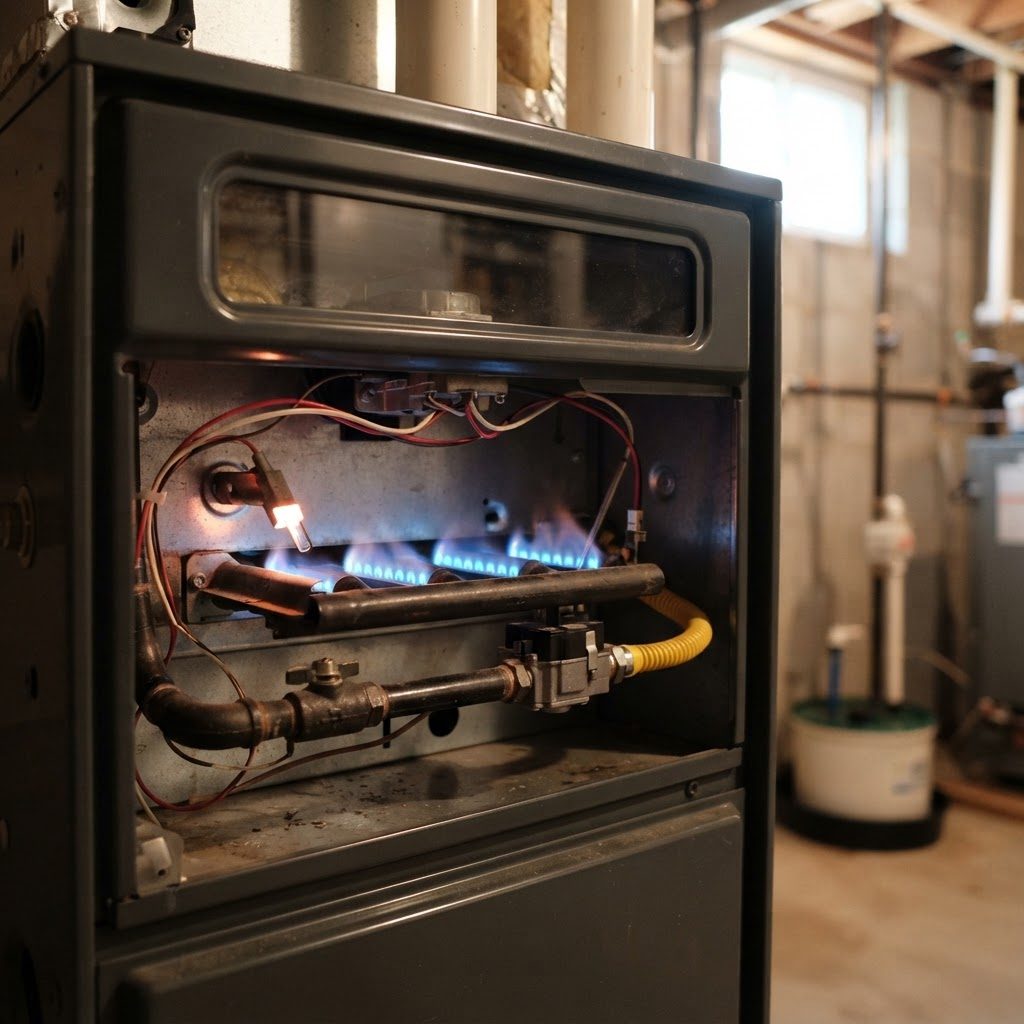
A furnace that will not heat is usually stuck at one step in a fixed sequence. Knowing which step failed is more useful than buying the last part a neighbor replaced. This page is that sequence for no-heat calls around the Green Bay metro. It is a scheduling guide. It is not a set of steps for opening a gas valve or defeating a safety switch.
The heating season here runs from September through May. Design lows sit near -10 F. In a polar vortex the furnace may run almost continuously, which is when a cracked igniter, a coated flame sensor, or a condensate hose full of water finally locks the burners out. When you request a visit, say whether the house is already cold and whether children or older adults are home. This referral service cannot promise a truck at a set hour. If a carbon monoxide alarm is sounding, leave and call emergency services instead of waiting on a form.
Start with what you can see without tools. Set the thermostat to heat, raise the setpoint, and check batteries if it uses them. Look for the furnace switch, often a toggle that looks like a light switch on the cabinet or a nearby joist. A switch bumped off when someone was moving boxes is a common false alarm. Then describe the sound. A thermostat that clicks and a furnace that stays silent is not the same job as a small fan that runs and then quits, or burners that light for a few seconds and die.
The order a furnace is supposed to start
On a normal call for heat the control checks the safety circuit first. That circuit includes high-limit switches, rollout switches, and often a door switch that opens when the blower door is off. The draft inducer then starts. It has to pull air through the heat exchanger and out the vent. A pressure switch closes only after that draft is real. Only then does a hot-surface igniter glow, or a spark start. The gas valve opens, flame has to be proven, and the blower starts on a delay so it is not pushing cold air. Older standing-pilot furnaces skip the glowing igniter. Their pilot must already be lit, held by a thermocouple.
If you can say where in that list the furnace stops, the first visit is shorter. Silent after the thermostat calls, inducer runs forever, igniter glows with no gas, burners light and drop out, or the cabinet gets hot and the blower never moves air. Those five patterns point at different parts.
Furnace igniter
Most furnaces installed since the 1990s use a hot-surface igniter, a small brittle stick that must glow before gas is allowed in. If it never glows, or it glows and the furnace locks out with no flame, the igniter is the first suspect, not the only one. Late gas, a dirty burner, or skin oil from the last replacement will crack a new igniter in days. Say if this is the second igniter of the winter. Replacing the stick without finding the cause is how the same house buys another one in February. The range in the table assumes a straightforward replacement on a furnace that is otherwise worth keeping.
Flame sensor
The flame sensor is a thin metal rod in the flame path. The flame conducts a tiny signal, on the order of a few microamps, back to the control. A white film of silica on the rod blocks that signal. The burners light, the board decides there is no flame, and the gas valve shuts within seconds. You may see a few attempts and then a lockout. Cleaning or replacing the sensor is often the smallest repair on a no-heat call. If a new sensor fails again the same season, the next look is burner alignment, grounding, and the board sense circuit, not a third sensor in a row.
Pressure switch
A pressure switch does not measure room temperature. It proves that the inducer is moving air and that the vent is not blocked. If the inducer runs and the igniter never receives power, the switch is often still open. Causes that show up every Green Bay winter include a cracked or water-filled rubber hose, a condensate trap backed up on a 90 percent furnace, a weak inducer, a tired diaphragm in the switch itself, and snow or ice over a sidewall plastic vent. Look at the outside pipes before assuming the board is dead, and clear snow only if you can do it without breaking the terminations.
Do not jumper a pressure switch, a rollout switch, or a limit to force the furnace to run. Those switches are what keep flue gas out of the rooms when the vent is not doing its job. A furnace that only runs with a safety bypassed is not a repaired furnace.
Blower
After the heat exchanger warms, the blower should start and the air at the registers should turn warm. If the motor is seized, the capacitor is weak, or the wheel is packed with dust because the furnace ran with no filter, the limit opens and the burners shut off while the cabinet is hot. The house gets a short blast of heat, or none, and the cycle repeats. Variable-speed motors fail in the electronic module as well as the bearings, and they sit at the high end of the blower range. A capacitor alone is often a smaller repair than a full motor. Ask the company that does the work to separate those two prices. A typical capacitor replacement in the metro is listed with the other parts.
The filter is the one homeowner item worth doing before the visit. A filter sucked into the blower, or a furnace run with the rack empty, loads the wheel with lint. Put a clean filter in, arrow pointing the way the air moves. Do not run the furnace with the blower door off. On many units that only opens the door switch and stops the cycle.
Thermocouple
Houses from the 1960s through the 1980s, common on the west side, in Fort Howard, and in older parts of De Pere and Allouez, still turn up with standing pilots. Efficiency on those furnaces can sit under 70 percent AFUE. The pilot flame heats the tip of a thermocouple, and that small signal holds the pilot valve open. If the pilot goes out the moment the knob is released, the thermocouple, a plugged pilot orifice, or the valve magnet may be at fault. A thermocouple is not the flame sensor on an electronic-ignition furnace. Naming the wrong part sends the wrong repair. If you are not sure which you have, say whether you see a standing pilot flame all summer or a glow stick only when the thermostat calls.
When a part is the wrong repair
Two findings should stop the parts conversation. A cracked heat exchanger is a safety problem, not something to seal, and on an older furnace it is usually a replacement rather than another control board. Repeated major repairs on a furnace past 20 years belong beside a replacement price, not stacked onto a tired cabinet. The replacement page walks through that choice, including 80 percent versus 95 percent equipment and propane on the rural edge of the county. When the same part fails twice in a season, a fall tune-up that logs flame signal, limits, and the vent is usually cheaper than a third visit.
Carbon monoxide alarms, a smell of flue gas, soot at the draft hood, or a headache that eases outdoors are not a filter problem. Leave if anyone feels ill and call emergency services. When you do schedule, say what the alarm did. A tune-up carbon monoxide check is not a substitute for alarms in the house.
What to put on the form: community, natural gas or propane, furnace or boiler, and the pattern. Silent, inducer only, lights then dies, or blower never comes on. The companies in this network service all major furnace brands, including Carrier, Trane, Lennox, Goodman, Bryant, Rheem, York, and American Standard, along with the older standing-pilot units common in pre-1990 Green Bay housing stock. Add the brand if you can read the cabinet. The table is typical for the metro. The company that does the work confirms the price after it sees the furnace. This site does not publish a technician roster or a shop address.
| Work | Typical for the metro | What the range assumes |
|---|---|---|
| Diagnostic visit | $89–$179 | Find which step in the light-off sequence failed |
| Hot-surface igniter | $180–$420 | Straightforward replacement when the furnace is worth keeping |
| Flame sensor | $130–$280 | Burners light for a few seconds, then the gas valve shuts |
| Pressure switch | $160–$360 | Inducer runs, igniter never powers, hose and vent are checked |
| Thermocouple | $120–$260 | Standing-pilot furnaces whose pilot will not stay lit |
| Blower motor | $450–$1,200 | No airflow or a furnace that overheats and locks out on the limit |
| Blower capacitor | $140–$300 | A smaller repair when the motor itself still turns |
Typical for the metro. These are planning ranges, not a quote and not a price from a specific contractor. The company that does the work confirms the price after looking at the equipment.
Same-day, emergency and after-hours furnace repair
A furnace that quits in a Green Bay January is an emergency by about hour three. This page covers no-heat repair, and the request form at the bottom of the page routes your job to local companies that do furnace repair in the metro. Submitting a request is free, and you only pay the company that actually does the work.
Emergency furnace repair: what actually counts as an emergency
Treat these as emergencies and act on them now: no heat at all when outdoor temperatures are near or below freezing, a carbon monoxide alarm sounding, the smell of gas near the furnace, or water pooling around the unit. For a gas smell or a CO alarm, leave the house and call your gas utility first. The repair can wait until the house is safe.
Same-day furnace repair: how a request gets routed
Requests submitted during the working day go to local companies in the order they respond. Whether a company can reach you the same day depends on their schedule that afternoon, which is why the form asks for the symptom and the community up front: a company with an open slot can judge in seconds whether it is a fit. Nobody can promise an arrival window before a company accepts the job, and any site telling you otherwise is guessing.
24-hour and after-hours furnace repair
After-hours requests are still routed, but they go to companies that answer after hours. In the Green Bay area that pool is smaller than the daytime pool, so an evening request may be picked up that night or first thing the next morning. Submit it either way. A request costs nothing, and it holds your place instead of leaving you to start over at 7am.
Before the technician arrives
Four checks settle a surprising number of no-heat calls without a visit: confirm the thermostat is set to heat and the setpoint is above room temperature, replace a filter that is visibly loaded with dust, check the breaker and the furnace switch, and confirm the gas valve at the unit is on. Clear snow or ice from the intake and exhaust pipes outside, because a blocked exhaust shuts a modern furnace down on purpose. Skip all of this if you smell gas.
What furnace repair costs in the Green Bay area
Repair prices in the metro follow the part, not the company. These are typical ranges homeowners see, and the company that visits confirms the actual price on site before any work starts.
- Diagnostic visit: roughly $89 to $150, sometimes credited against the repair
- Hot surface igniter: roughly $180 to $350, the most common no-heat repair
- Flame sensor clean or replace: roughly $120 to $250
- Inducer motor: roughly $450 to $900
- Blower motor: roughly $450 to $1,100 depending on variable speed
- Control board: roughly $350 to $800
- Heat exchanger: usually the point where replacement is the better spend
When furnace repair stops making sense
Three signals point at replacement rather than repair: a heat exchanger that has cracked, a furnace past roughly 15 years old with a second major failure in two seasons, or a repair quote that lands near a third of what a new furnace costs. Ask the visiting company for the age of the unit and the parts warranty before you decide, and get the repair-vs-replace comparison in writing. The furnace replacement page covers what a swap involves and how sizing is decided.
Commercial furnace and rooftop unit repair in Green Bay
A shop, warehouse office, restaurant or small commercial building does not heat like a house. Most of that stock runs packaged rooftop units, unit heaters in the shop, or a boiler feeding a loop, and the failure modes and the scheduling are different from a residential call.
Packaged rooftop units
A packaged unit carries its own burners, blower and controls on the roof, so a no-heat call is that unit, not a furnace in a basement. Belts, bearings, economizer dampers and the control board are the usual suspects, and roof access plus a disconnect are part of every visit.
Unit heaters in shops and warehouses
A suspended unit heater that will not fire is often a blocked flue or a pressure switch, and a shop with a big overhead door sees far more cycling than a house. Two heaters in one bay where one has failed is the most common call we see: the space stays warm enough to hide the fault until the cold snap.
Commercial scheduling and downtime
The driver on a commercial call is when the building is empty rather than when the technician is free. Give the request an access window, a site contact, the unit count and which zones are affected, and say whether the work has to be after hours. That single detail decides which companies can take the job at all.
What commercial heating work costs
Ranges, confirmed on site: commercial diagnostic roughly $125 to $250, belt and bearing service roughly $200 to $500, igniter or flame sensor roughly $200 to $450, blower motor roughly $500 to $1,300, and packaged rooftop replacement is a quoted project rather than a service call.