HomeFurnace parts
Furnace parts and typical metro prices
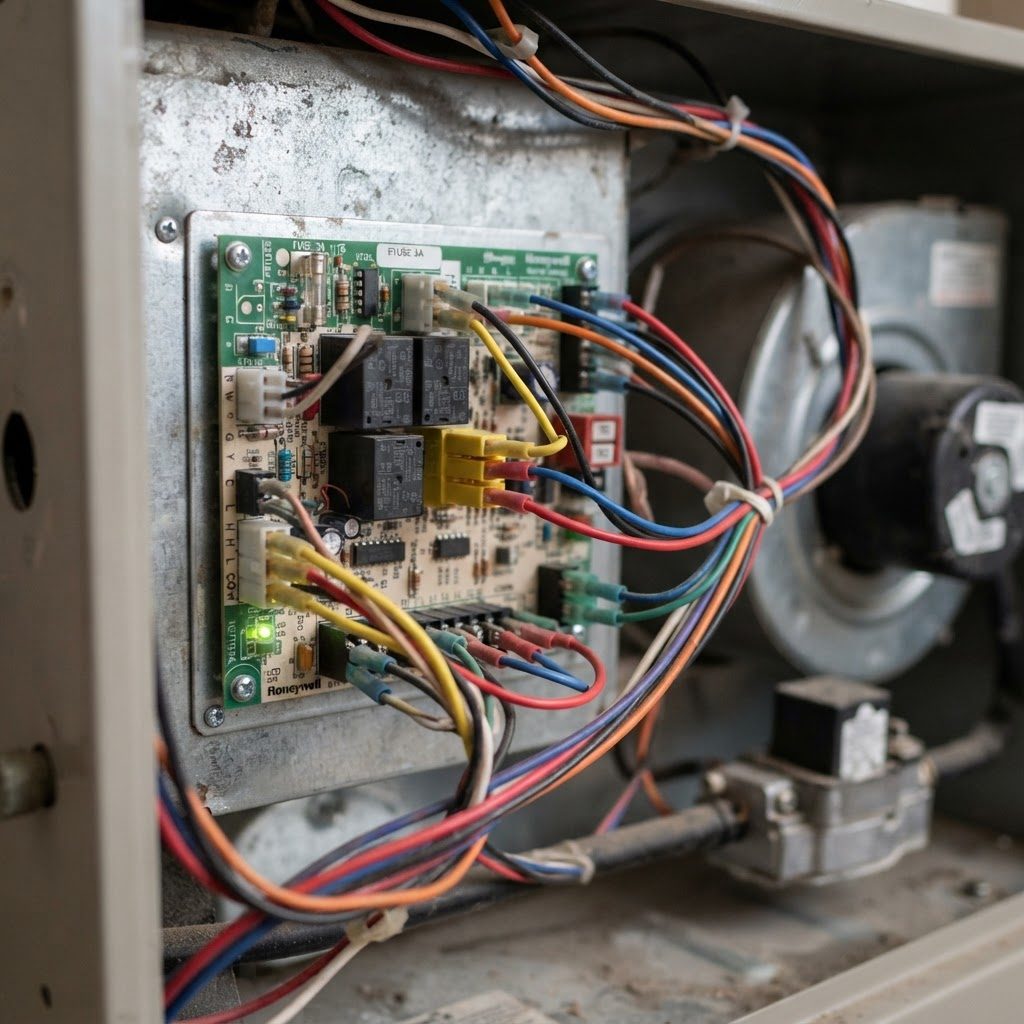
Parts prices on a furnace are only useful next to the question of whether the furnace should get the part. The ranges below are typical for the Green Bay metro for a straightforward replacement, labor included, when the rest of the furnace is worth keeping. They are not a quote. Difficult access, after-hours calls, and a second fault found during the repair land outside the band. The company that does the work confirms the number after it sees the cabinet.
Read the symptom before you read the price. An igniter, a flame sensor, a blower motor, a control board, and a draft inducer fail in different ways. Putting the expensive part in first is how a house pays for a board when the pressure-switch hose was full of water. The no-heat page walks the light-off sequence. This page is the parts themselves.
Igniter prices
The hot-surface igniter glows, then the gas valve opens. If the element is cracked or open, the furnace may click through a trial and lock out, or it may never get past the inducer. Igniters are brittle. A new one that fails within weeks was often damaged by late ignition, a dirty burner, short cycling, or oil from handling. Match the part to the furnace model. A look-alike from a different series can glow and still be the wrong resistance or warm-up time for that board. The metro range assumes the valve and the board are doing their jobs. If this is a repeat igniter, say so on the form.
Flame sensor prices
The flame sensor proves that gas is actually burning. Coated with silica, it tells the board the flame is missing, and the valve shuts a few seconds after a good light-off. It is often the least expensive repair on this list, which is why it gets tried first when the pattern is lights-then-dies. It is not a cure for a bad ground, a misaligned burner, or a board that can no longer read the signal. A sensor replaced twice in one heating season is a reason to stop buying sensors.
Blower motor prices
The blower moves heat off the exchanger and into the rooms. When it does not, the limit trips, the burners stop, and the cabinet is hot while the registers are not. Older furnaces usually have a standard motor plus a separate capacitor. The capacitor is the cheaper failure and should be priced as its own repair when the motor still spins. Variable-speed motors combine the motor and a module. They are quieter and they cost more when the module fails, which is why the blower range is wide. A wheel caked with dust from a missing filter can look like a weak motor. Cleaning the wheel is not the same invoice as replacing the motor. Ask which one is being proposed.
Control board
The board sequences the inducer, igniter, valve, and blower, and it stores the lockout. A dead board can leave the furnace silent or can leave the blower running without end. Boards also get blamed for open safety switches. A limit that is open, a rollout that tripped, or a pressure switch that never closes will all keep a good board from lighting the burners. Ask what measurement showed the board itself was bad: a missing output with proven inputs, not a guess after one lockout. Flashing lights are a code, and the code legend is usually on the blower door. Write the pattern down if you can, without standing in front of an open burner compartment. Obsolete boards on furnaces past 20 years are a replacement conversation, because the part can cost more than the remaining life of the cabinet, and sometimes the exact board is no longer sold.
Draft inducer
The inducer is the small fan that proves draft before ignition. If it does not start, nothing downstream is allowed to. If it runs but cannot pull enough draft, the pressure switch stays open and the igniter never glows. Bearings get noisy. On condensing furnaces the inducer housing also sees water. A blocked trap or a frozen drain pushes condensate where it does not belong and kills inducers that were otherwise fine. Replacing the inducer without clearing the drain repeats the failure. Snow buried over the outside vent is the winter version of a blocked flue. Check that before you approve an inducer, if you can see the pipes safely from the yard.
Pressure switches and thermocouples are on the table because they are common, even though they are not the five parts people price first. A pressure switch is a safety device. Replace it when the hose, the drain, and the vent are actually clear and the switch still will not close, not as a shortcut around a blocked flue. A thermocouple belongs to standing-pilot furnaces. It is the wrong part number for a flame-sensor fault on an electronic furnace.
When not to buy the part
Skip the major part when the heat exchanger is cracked, when the furnace is below about 70 percent AFUE and already needs a board or a blower, or when the furnace is 20 years or older and this repair is one of several large ones. A single igniter or sensor on an otherwise sound furnace is still a repair, even at 18 years. A board plus an inducer plus a blower on a 24-year-old natural-draft furnace is usually not. Compare the firm repair price with a firm replacement price from the company that will do either job. Financing is not offered here. Ask that company. The ranges above are typical for the metro and nothing else.
| Work | Typical for the metro | What the range assumes |
|---|---|---|
| Hot-surface igniter | $180–$420 | Part and labor when the furnace is worth keeping |
| Flame sensor | $130–$280 | Clean or replace; often the smallest no-heat repair |
| Blower motor | $450–$1,200 | Standard motors lower, variable-speed modules higher |
| Blower capacitor | $140–$300 | When the motor still turns and the capacitor is weak |
| Control board | $400–$950 | After switches and the inducer are proven, not instead of them |
| Draft inducer | $380–$850 | No draft, noisy inducer, or water damage on a condensing furnace |
| Pressure switch | $160–$360 | Only after the hose, drain, and vent are checked |
| Thermocouple | $120–$260 | Standing-pilot furnaces, not electronic flame sensors |
Typical for the metro. These are planning ranges, not a quote and not a price from a specific contractor. The company that does the work confirms the price after looking at the equipment.
Related: how the sequence fails and when replacement is the better spend.