Ten direct answers about cost, age, safety, and how a visit gets booked. This site schedules the work. It does not quote a firm price from a form, and it does not publish ratings or a warranty of its own.
Should I repair the furnace or replace it?
Repair when the heat exchanger is intact and the failed part is a modest share of what a new furnace would cost. Replace when the heat exchanger is cracked, when the furnace is below about 70 percent AFUE and needs a major part, or when the unit is 20 years or older and the next repair is a large one, such as a blower, a board, and an inducer in the same season.
There is no universal dollar cutoff on this site. Ask the company that does the work for a firm repair price and a firm replacement price, then compare them. Typical metro ranges for common repairs, and for 80 percent versus 95 percent equipment, are on the parts and replacement pages. They are planning ranges, not a quote.
How long do furnaces last in this climate?
Plan on about 15 to 20 years from a forced-air furnace in the Green Bay metro. The heating season runs from September into May, and design lows sit near -10 F. During a polar vortex the furnace may run almost continuously, which ages igniters, boards, and blower motors faster than in a mild climate.
Some furnaces last longer when the filter stays clean and someone does a real fall tune-up. A condensing furnace can fail earlier if the condensate drain was ignored and water sat in the inducer. Age alone is not a reason to scrap a furnace that still lights, holds a normal temperature rise, and has an intact heat exchanger.
Why does the igniter keep failing?
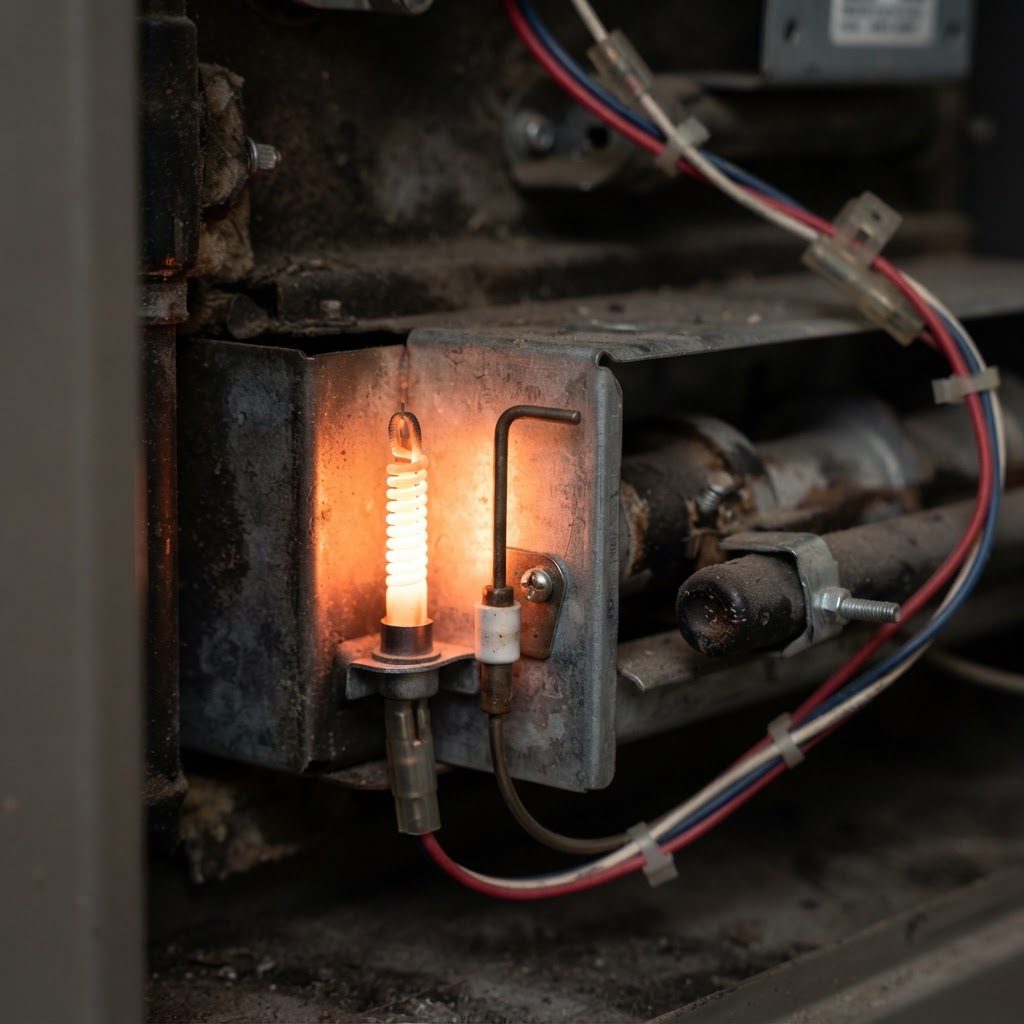
A hot-surface igniter is a brittle element. A new one can crack quickly if gas is slow to light, a burner is dirty, the furnace short-cycles, or someone handled the element and left oil on it. Replacing the igniter without asking why it failed is how a house goes through more than one igniter in a single winter.
Older standing-pilot furnaces have no hot-surface igniter. Those use a thermocouple or a similar pilot sensor, which is a different part. Tell the scheduler if an igniter was already replaced, and whether the burners light before the failure.
How should I handle carbon monoxide risk?
Treat carbon monoxide as an emergency, not as a scheduling detail. If a carbon monoxide alarm sounds, or people in the house have headaches or nausea that ease when they go outside, leave the house and call emergency services. Do not open a window and wait to see.
Furnaces can produce carbon monoxide when a heat exchanger is cracked, a vent is blocked or disconnected, or a chimney is spilling. A fall tune-up should include a carbon monoxide measurement, and the house should have listed carbon monoxide alarms. One annual test does not replace the alarms. This form cannot diagnose carbon monoxide.
When should I schedule a tune-up?
Book the annual tune-up in September or October, before the first long cold spell. Green Bay heating runs from September into May. Waiting until the first night near zero puts you behind no-heat calls.
A tune-up is a checklist and a safety test. It is not a promise that nothing will fail in January. The tune-up page lists what a fall visit should cover, including the condensate drain on a condensing furnace and a look at the vent pipes before snow builds over them.
Which furnace brands can be scheduled?
Companies reached through this scheduling service routinely work on brands common in Brown County houses: Carrier, Bryant, Trane, American Standard, Lennox, Rheem, Ruud, Goodman, Amana, York, and older private-label furnaces sold by home stores and local dealers.
That is not a factory-authorization claim, and it is not a promise that an obsolete board is on the truck that day. If you can read the brand on the cabinet, put it in the message. If you cannot, describe the equipment: upflow in a basement, horizontal in a crawlspace, or a boiler with radiators.
What if there is no heat during a polar vortex?
No-heat calls are the priority when the weather is extreme, but this referral service cannot promise a technician at a set hour. Use the form and say that the house has no heat, and say if children or older adults are home.
While you wait, keep return-air paths open. Do not use a gas oven or an unvented heater as a furnace. If the house is dangerously cold and no visit is available, go somewhere warm. Suspected carbon monoxide is an emergency call, not a request on this form.
Do you offer financing?
No. This scheduling service does not offer financing, loans, or payment plans, and it does not quote interest rates. Ask the company that does the work whether they offer any payment option, and read the agreement yourself before you sign. Nothing on this site is a credit offer.
Is there a warranty on repairs?
Any warranty on parts or labor comes from the company that does the repair and from the part manufacturer. This scheduling service does not publish a warranty of its own and does not set the coverage period.
Before work starts, ask what is covered, for how long, and whether both labor and the part are included. A manufacturer warranty may require proof of maintenance, and it may not include labor even when the part itself is covered.
How does scheduling work?
Send the form with your name, phone, email, community, the kind of work, and a short description of the equipment and the symptom. A scheduler uses that to line up a local company. You are not choosing a named technician on this website, and the form is not a firm price.
The company that comes out confirms what failed, what they recommend, and what it will cost before they repair or replace anything. If you do not hear back, send the form once more rather than many copies.