HomeFall tune-up
Fall furnace tune-up before a Green Bay winter
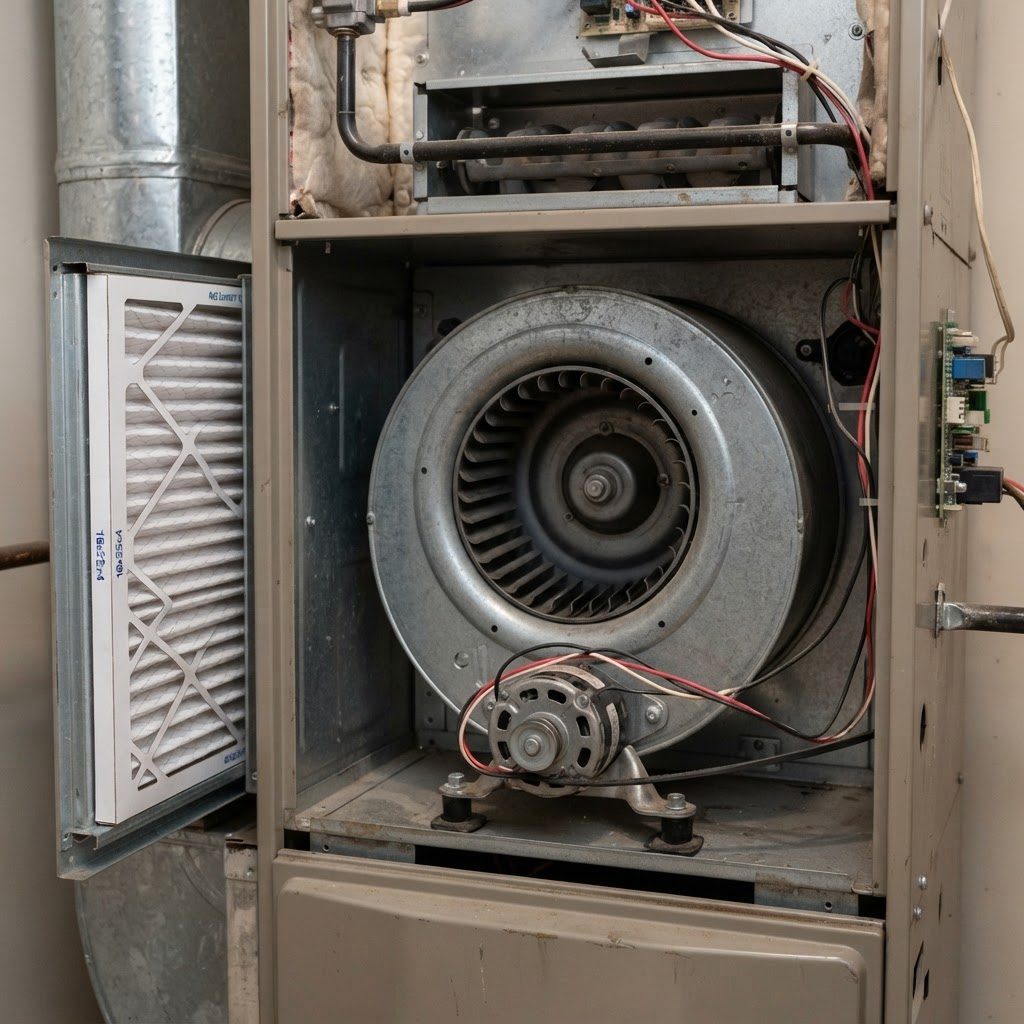
A tune-up is a checklist and a safety test done before the furnace is asked to run for days at a time. In the Green Bay metro that request is not theoretical. The heating season runs from September through May. Design lows sit near -10 F. During a polar vortex the burners and the blower may barely shut off. A marginal igniter, a flame sensor with a film on it, or a condensate trap that is starting to hold water will survive October and fail on the coldest night of January, when every no-heat call in Brown County is competing for the same parts.
Book the visit in September or October. That leaves time to order a board or an inducer before the first long stretch of single-digit weather. Waiting until the house is already cold turns a tune-up into an emergency, and emergency visits are a different kind of scheduling. This page describes what a fall visit should cover. It is not a promise that a tuned furnace cannot fail later, and it is not a duct-cleaning package.
Why the timing is local
Green Bay is not a mild shoulder-season climate with a few cold weeks. Furnaces here earn their age. Lake Michigan takes the edge off a few storms and does not make January gentle. Sidewall vents on 90 percent and 95 percent furnaces ice over or disappear under drifts. Masonry chimneys on older 80 percent furnaces and on boilers in Astor and downtown have to draft when the wind is wrong and the outdoor temperature is far below the flue gas. A fall visit is the chance to see those problems while the house still has heat.
Condensing furnaces, common in Howard, Suamico, Bellevue, and newer edges of De Pere, add a freeze problem the older metal-vent furnaces do not have. The condensate drain, the trap, and any pump have to stay clear. A trap full of debris makes the pressure switch stay open. A drain that freezes in an outside wall shuts the furnace down in the same way. The fall checklist puts eyes on that path before the first hard freeze, not after.
What the checklist actually includes
A useful tune-up is specific. Filter size and condition come first, including whether last year's filter collapsed into the blower. The thermostat gets a call for heat so the technician sees the real sequence, not just a meter reading on a cold cabinet. On older mechanical thermostats the question is whether they still complete a call, not a lab calibration certificate.
Blower compartment and capacitor
The blower compartment should be looked at, not assumed. Dust packed on a wheel, a noisy bearing, and a weak capacitor are visible or measurable, and the motor amp draw can be compared with the nameplate. Burners should light with a steady blue flame rather than a lazy yellow flame that lifts off the burner. A little orange at the first moments of ignition can be dust. A flame that stays yellow and sooty is a combustion problem.
Flame sensor and igniter
The flame sensor gets inspected and cleaned when it is coated. The igniter gets a visual check. The element is not a handle. Touching it is a good way to condemn a part that was fine. The inducer should start cleanly and should not sound like it is pumping water. The pressure-switch hose should be soft, cracked hoses replaced in the conversation, not ignored. On condensing equipment the trap and drain get cleared and the termination outside gets a look for height above the usual snow line.
Heat exchanger inspection
The heat exchanger gets a visual inspection through the burner opening or a factory port. A visual look is not a guarantee that no crack exists. It is still worth doing, and a technician who sees rust trails, a separated cell, or flame that changes when the blower starts should stop and talk about safety rather than selling a cleaning. Temperature rise, supply versus return, gets compared with the range printed on that furnace. There is no single correct rise for every model.
Gas smell is a stop-work item. Measuring gas pressure and clocking the meter belongs to the person qualified to do it on site, not to a checklist you finish yourself. Safety controls, the limit, the rollout, and the door switch, get confirmed, not jumped out. The furnace should complete a cycle and return to standby without a locked error code.
Carbon monoxide check
A fall tune-up in this climate should include a carbon monoxide measurement in the flue and an ambient check in the mechanical room while the furnace runs. Cracked heat exchangers, blocked chimneys, disconnected vents, and backdrafting water heaters are the reasons. The test is a reading at a visit. It does not replace listed carbon monoxide alarms on the floors where people sleep. If an alarm sounds or anyone feels ill, that is an emergency, not a tune-up appointment.
Older chimneys in Allouez, De Pere, Astor Park, and downtown Green Bay deserve extra attention because more than one appliance may still share a flue that was sized for a different era. Spillage at a draft hood is not solved by a new filter. Newer houses with outdoor-air PVC vents have a different failure: a termination plugged with snow, or a nest, that makes the pressure switch tell the truth and keep the burners off. Both belong on the checklist.
What a tune-up does not include
It is not an automatic parts replacement, not a warranty that the furnace will survive a polar vortex, and not a cleaning of the whole duct system. It does not raise the AFUE of a 60 percent standing-pilot furnace into the 90s. If the visit finds a cracked heat exchanger, a furnace under about 70 percent AFUE that needs a major part, or a 20-year-old unit with a repair that is climbing toward replacement money, the honest result is a conversation about replacement, not a stack of new parts. Humidifier pads, if a bypass humidifier is installed, are reasonable fall maintenance because these houses run dry when it is far below freezing. That is comfort, not combustion safety.
The range in the table is typical for the metro for a straightforward annual visit. It is not a quote, and it is not a night-and-weekend emergency rate. Ask whether a diagnostic fee is separate if the furnace will not run. Financing is not offered by this scheduling service. Ask the company that does the work. Put the community and the fuel on the form, and say if the furnace is already dead or you are booking ahead of the cold.
| Work | Typical for the metro | What the range assumes |
|---|---|---|
| Annual fall tune-up | $109–$199 | Checklist below, including a carbon monoxide check |
| Diagnostic if it will not run | $89–$179 | A tune-up that turns into a no-heat diagnosis |
Typical for the metro. These are planning ranges, not a quote and not a price from a specific contractor. The company that does the work confirms the price after looking at the equipment.
Related: no-heat diagnosis, when to book, carbon monoxide.