HomeFurnace replacement
Furnace replacement in the Green Bay metro
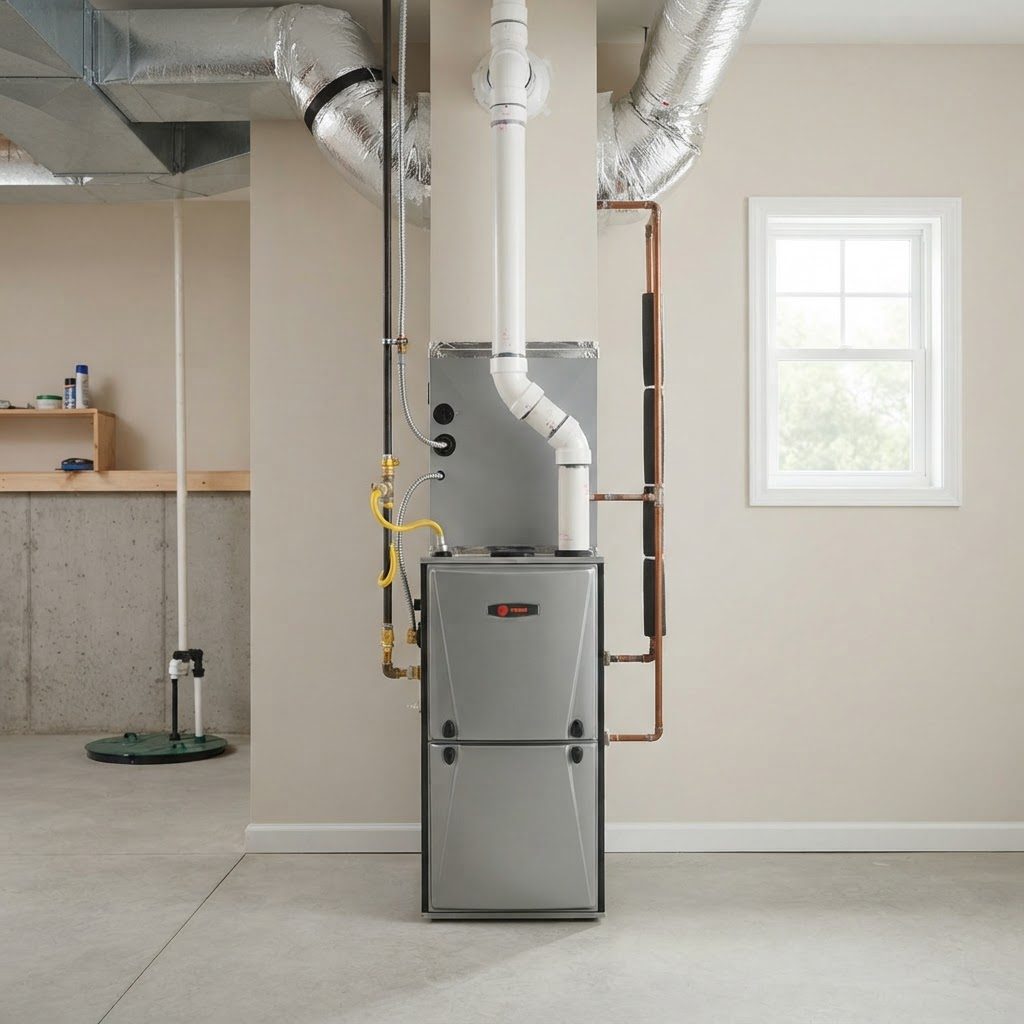
Replace the furnace when the heat exchanger is cracked, when efficiency is below about 70 percent AFUE and the unit needs a major part, or when the furnace is 20 years or older and the next repair is a large one. A single igniter or flame sensor on a safe furnace is still a repair. There is no universal dollar cutoff. Get a firm repair price and a firm replacement price from the company that will do the work, and compare those two numbers, not a rumor from a form.
The form on this page requests scheduling. It does not confirm a model, a size, or a price. Financing is not offered by this scheduling service. Ask the company that does the work what payment options they have, and read any agreement yourself before you sign.
Cracked heat exchanger
The heat exchanger is the metal that keeps combustion gas out of the air you breathe. A crack, a separated cell, or a gasket failure that lets flue gas into the supply air is a safety failure. Signs can include carbon monoxide in the supply, soot, a flame that changes when the blower starts, or a reading the technician does not like. None of those signs are something to confirm from a hallway. Do not seal a crack with furnace cement and keep running the furnace. On an older cabinet, replacing only the exchanger is rarely money well spent compared with a new furnace, because the labor is heavy and the rest of the unit is the same age. The company doing the work has to make the call after looking. If a carbon monoxide alarm has already sounded, leave the house and call emergency services first.
AFUE under 70 percent
AFUE is the seasonal efficiency printed on the rating plate or the EnergyGuide label, not a guess from the shape of the cabinet. Standing-pilot, natural-draft furnaces from the 1960s and 1970s often land in the 60s. Some 1980s equipment sits in the 70s. If the plate is painted over, age and a standing pilot are clues, not a measurement. A furnace under about 70 percent can still heat a house. Across a Green Bay season that runs from September through May, it uses more gas to do it, and a polar vortex makes that furnace run nearly full time. One modest repair can still be rational if the exchanger is intact and you need a short bridge of heat. A major repair on that cabinet is usually the moment to price a replacement instead of renewing a 60 percent furnace for another five years.
Furnace age of 20 years and up
Twenty years is not a death sentence. It is the point where one more expensive repair deserves a side-by-side price. In this climate a forced-air furnace often gives about 15 to 20 years of reliable service, sometimes more with clean filters and real fall maintenance, sometimes less if a condensing unit sat with a blocked drain. A sound 22-year-old furnace with a bad igniter is a parts job. A 22-year-old furnace that now needs a board, an inducer, and a blower is a replacement job unless the firm prices say otherwise. People sometimes use a rough test of whether the repair is a small fraction of replacement or a large one. That is a comparison, not a rule this site enforces.
80 percent versus 95 percent
An 80 percent furnace vents through metal pipe, often a B-vent or a lined chimney. It does not make much condensate. It has fewer parts than a condensing furnace, and in a house that already has a sound chimney it can be the practical choice. The metro range for a straightforward changeout is on the table. It assumes the ductwork, the pad, and the electrical circuit do not need to be rebuilt.
A 95 percent or better furnace pulls more heat from the same gas and vents through plastic pipe, usually out a sidewall, with a second pipe or a concentric kit for combustion air. It needs a condensate drain that will not freeze, pitched correctly, with the trap able to hold. Those furnaces fit newer houses in Howard, Suamico, Bellevue, and the newer edges of De Pere especially well, and they also fit older houses when the vent route and the drain are real, not wished for. The higher efficiency is not automatically the better buy. A house with a short remaining time horizon, or a drain path that would freeze in an exterior wall, can be a better match for 80 percent. Fuel savings are not a guaranteed dollar figure. They depend on rates, insulation, and how warm you keep the house. Nobody honest prints a payback as a fact without seeing the utility bills.
Complicated venting, a chimney liner, asbestos or vermiculite discovered in a closet, a new return, or a permit path the village requires can move either price up. This site does not invent permit fees. Ask the company that does the work what is included.
Sizing should not be copied off the old nameplate alone. Many furnaces from the 1970s and 1980s were larger than the house needed, and a same-size replacement short-cycles, makes noise, and wears the new igniter out early. The company doing the install should size from the house. This scheduling service does not run that calculation from a web form.
Propane on the rural edge
Inside Green Bay, De Pere, Allouez, and Ashwaubenon, natural gas is the usual fuel. Howard and Bellevue are mostly gas as well. Wrightstown, parts of southern Brown County, and some larger lots in Suamico are propane. A furnace built for one fuel is not assumed safe on the other. A listed conversion kit, the correct orifices, and the valve setting the manufacturer specifies are the job of the company doing the work, not a field guess. Tell the scheduler which fuel is actually connected.
An empty propane tank looks like a dead furnace from the hallway. The burners will not stay lit because gas pressure collapses. If you can check the tank gauge safely from outside, do that before you assume the control board failed, and still mention the fuel on the form. Outbuildings on the same tank are worth a sentence too.
What the visit decides
Scheduling a replacement visit means someone looks at the existing furnace, the vent, the drain path, the ducts, and the fuel, then gives you a price for the option that fits. You can still choose a repair if the exchanger is safe and the number makes sense. You can decline both. Nothing on this page is a financed offer, a rebate guarantee, or a promise of a specific brand. Brands common in the metro are listed in the FAQ, as a description of what companies work on, not as a dealer badge.
The ranges below are typical for the metro. Use them to tell a reasonable proposal from a wild one. Do not use them as the price of your house.
| Work | Typical for the metro | What the range assumes |
|---|---|---|
| 80% furnace, straightforward changeout | $3,200–$5,800 | Metal vent stays workable, no major duct rebuild |
| 95%+ furnace, straightforward changeout | $4,800–$8,900 | PVC vent and a condensate drain, ducts basically sound |
| Repair benchmark, igniter | $180–$420 | Shown so a small repair is not confused with a changeout |
| Repair benchmark, control board | $400–$950 | A large repair that should be priced beside replacement |
Typical for the metro. These are planning ranges, not a quote and not a price from a specific contractor. The company that does the work confirms the price after looking at the equipment.
Related: repair diagnosis, part ranges, propane and farmhouses, fix or replace.