Why does my furnace short cycle?
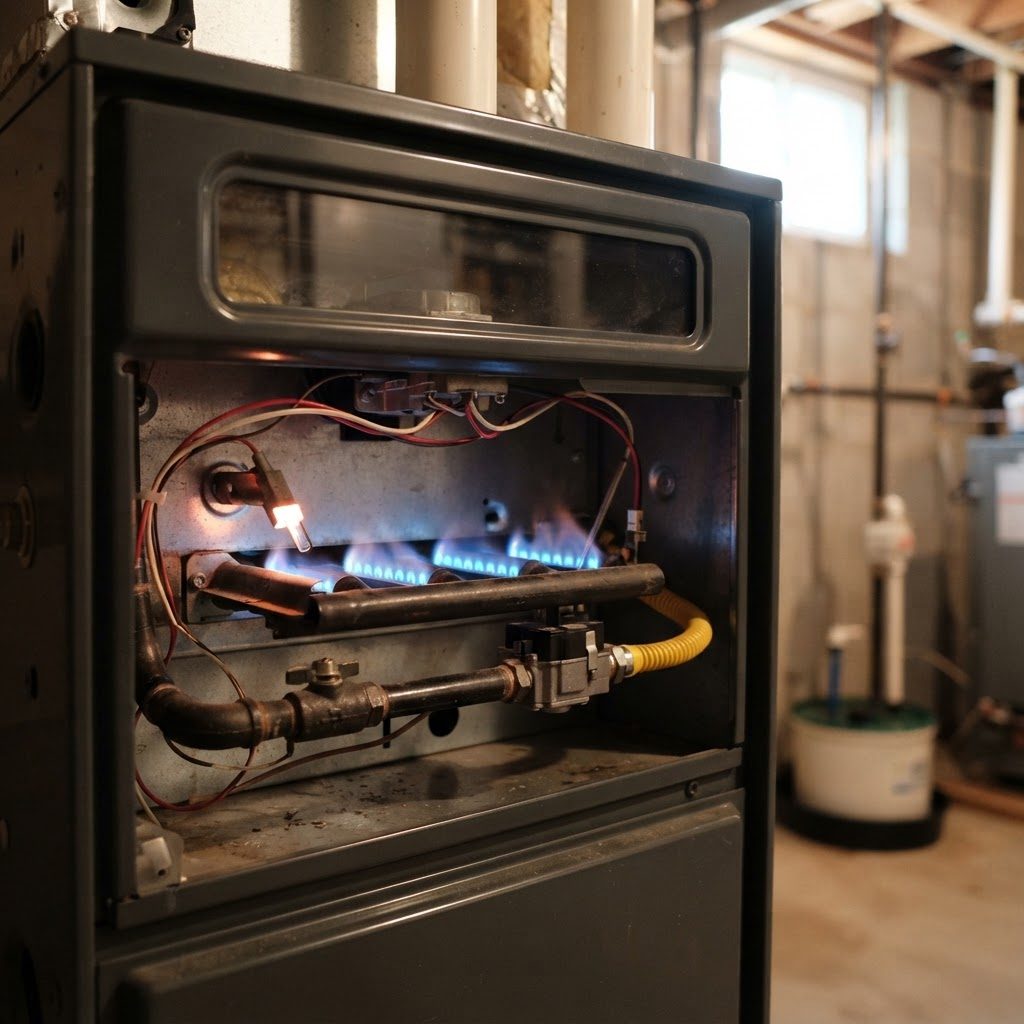
Short cycling means the furnace lights, runs for a few minutes, shuts off, and repeats. It is the most common furnace complaint that is not a breakdown, because most short cycling is air flow or sizing rather than a failed part. It also wears a furnace out faster than running long cycles, since every start is a thermal shock to the heat exchanger.
The five things that cause short cycling
In a Green Bay house in winter, the order of suspicion runs from cheapest and most common to the expensive answer.
A filter that is loaded with dust
Restricted air flow is the first cause for a reason. The furnace has a high-limit switch that shuts the burner down when the heat exchanger gets hotter than it should, and a starved furnace overheats in minutes. A filter that looks grey usually is restricted. Change it and see whether the behaviour stops before spending anything on parts.
A high limit switch doing its job
The limit switch is a safety device, not a fault. If it trips, something upstream is wrong: filter, a closed or crushed return duct, a blower wheel caked with dust, or a blower running slower than it should. Replacing the switch without finding the restriction just means the new switch trips too.
A dirty flame sensor
A flame sensor that has lost its coating will fail to prove flame after a few seconds and the burner shuts down. The pattern is a short run, a shutdown, then a retry, sometimes three attempts before lockout. Cleaning the sensor is a small job, and it explains a lot of "short cycle" calls.
A furnace that is oversized for the house
This one does not get fixed with a filter. An oversized furnace brings the house to temperature faster than it can move the air, hits its limit, and stops. The tell is short cycles in milder weather, long or continuous running in a cold snap, and a unit whose output is well above what the house's heat loss actually calls for. The real answer is a load calculation rather than a bigger or smaller guess.
A blocked flue or intake
High-efficiency furnaces pull combustion air from outside and push exhaust through PVC. Snow, ice, a bird screen packed with lint, or a pipe that sags and collects condensate all restrict it, and the pressure switch shuts the furnace down. In Green Bay this is worth checking first after a snow event.
When short cycling is a safety issue
Two symptoms change the urgency. A cracked heat exchanger can cause short cycling through limit trips, and it is a carbon monoxide risk. A rollout switch that trips means flame is escaping where it should not, and it must not be reset repeatedly. If a carbon monoxide alarm has sounded, leave the house and call your gas utility.
What this costs to fix in Green Bay
Typical ranges, confirmed on site by the company that visits:
- Diagnostic visit: roughly $89 to $150
- Filter and air flow correction: often no charge beyond the visit
- Flame sensor clean or replace: roughly $120 to $250
- High limit switch: roughly $180 to $320, and only after the cause is found
- Blower wheel or motor service: roughly $350 to $1,100
What to tell the company
How long it runs before shutting off, whether the burners light at all, how often it repeats, whether the fan runs after the burners stop, and the last time the filter was changed. That separates an air flow problem from an ignition problem before anyone drives out. If the furnace is failing to keep up as well as short cycling, the furnace repair page covers the no-heat diagnosis order.